Gettysburg Sculptures


Gettysburg Sculptures

United States

  • Gettysburg Sculptures Home
  • The Great 50th Reunion of the Battle of Gettysburg RememberedClick to open the The Great 50th Reunion of the Battle of Gettysburg Remembered menu
    • 1913 Reunion Mementos and Souvenirs
  • ITEMS FOR SALE
  • Contact Gettysburg Sculptures
  • About Us
  • Quick Index to Sculptors at Gettysburg
  • Quick Index to Northern Equestrian Monuments at Gettysburg
  • Quick Index to Bronze Southern State Monuments at Gettysburg
  • Father William Corby Portrait StatueClick to open the Father William Corby Portrait Statue menu
    • Samuel A. Murray Sculptor of the Father Corby Portrait Statue
  • Maj-Gen Hancock Equestrian MonumentClick to open the Maj-Gen Hancock Equestrian Monument menu
    • Frank Edwin Elwell Sculptor of the Hancock
  • Louisiana State Memorial Click to open the Louisiana State Memorial  menu
    • Louisiana State Memorial Sculptor Donald De Lue
  • Mississippi MonumentClick to open the Mississippi Monument menu
    • Donald De Lue sculptor of the Mississippi Memorial
  • Soldiers & Sailors of the Confederacy MonumentClick to open the Soldiers & Sailors of the Confederacy Monument menu
    • Donald De Lue sculptor of the Soldiers & Sailors Monument
    • The 1941 Proposed Location of the Longstreet Memorial
  • Virginia State MemorialClick to open the Virginia State Memorial menu
    • General Robert E. Lee bronze atop the Virginia Memorial
    • The bronze "group" at the base of the Virginia Memorial
  • Bronze Bas-Relief at Gettysburg Page 1 of 2Click to open the Bronze Bas-Relief at Gettysburg Page 1 of 2 menu
    • Bronze Bas-Relief at Gettysburg Page 2
  • Brig. General John Buford MonumentClick to open the Brig. General John Buford Monument menu
    • James E Kelly, Sculptor of the Buford Bronze Statue
  • Brig. General Samuel Crawford MonumentClick to open the Brig. General Samuel Crawford Monument menu
    • Ron Tunison, sculptor of the Crawford Monument
  • Delaware Memorial at GettysburgClick to open the Delaware Memorial at Gettysburg menu
    • Ron Tunison, Sculptor of the Delaware Memorial Bronze
  • Friend to Friend Masonic MemorialClick to open the Friend to Friend Masonic Memorial menu
    • Ron Tunison, Sculptor of the Friend to Friend Masonic Memorial
  • Gen. Sedgwick Equestrian MonumentClick to open the Gen. Sedgwick Equestrian Monument menu
    • H.K. Bush Brown sculptor Sedgwick Equestrian Monument
  • Gen. Slocum Equestrian MonumentClick to open the Gen. Slocum Equestrian Monument menu
    • Edward C. Potter sculptor Slocum Equestrian Monument
  • General John Gibbon MonumentClick to open the General John Gibbon Monument menu
    • Terry Jones sculptor of the Gen. John Gibbon Statue
  • General A. A. Humphreys MonumentClick to open the General A. A. Humphreys Monument menu
    • J. Otto Schweizer sculptor of the A. A. Humphreys Statue
  • Maj-Gen. Meade Equestrian MonumentClick to open the Maj-Gen. Meade Equestrian Monument menu
    • H. K. Bush Brown Sculptor Meade Equestrian Monument
  • North Carolina State MonumentClick to open the North Carolina State Monument menu
    • Sculptor of the North Carolina Monument Gutzon Borglum
  • John F. Reynolds Monument National CemeteryClick to open the John F. Reynolds Monument National Cemetery menu
    • J. Q. A. Ward sculptor of the Reynolds in the Cemetery
  • Major - Gen. James S. Wadsworth MonumentClick to open the Major - Gen. James S. Wadsworth Monument menu
    • R. Hinton Perry Sculptor of the Maj. Gen. Wadsworth Bronze
  • Gen. G.K. Warren MonumentClick to open the Gen. G.K. Warren Monument menu
    • Karl Gerhardt sculptor of the General Warren Monument
  • Gen. Webb MonumentClick to open the Gen. Webb Monument menu
    • J. Massey Rhind sculptor of Webb Memorial
  • Women's Memorial (Elizabeth Thorn) at GettysburgClick to open the Women's Memorial  (Elizabeth Thorn) at Gettysburg menu
    • Ron Tunison, Sculptor of the Women's Memorial
  • Albert Woolson MonumentClick to open the Albert Woolson Monument menu
    • Avard Fairbanks sculptor of the Albert Woolson Statue
  • 6th New York Cavalry MonumentClick to open the 6th New York Cavalry Monument menu
    • James E. Kelly sculptor 6th N.Y. Cavalry Monument
  • 9th New York Cavalry MonumentClick to open the 9th New York Cavalry Monument menu
    • Caspar Buberl sculptor of the 9th NY Cavalry Monument
  • 111th New York Infantry MonumentClick to open the 111th New York Infantry Monument menu
    • Caspar Buberl Sculptor of the 111th New York Infantry Bronze Statue
  • 11th Mississippi Infantry MonumentClick to open the 11th Mississippi Infantry Monument menu
    • William Beckwith sculptor of the 11th Mississippi Inf. Monument
  • 11th Pennsylania Infantry MonumentClick to open the 11th Pennsylania Infantry Monument menu
    • E. A. Kretschman Sculptor of the 11th PA Infantry Monument

Featured Monument:

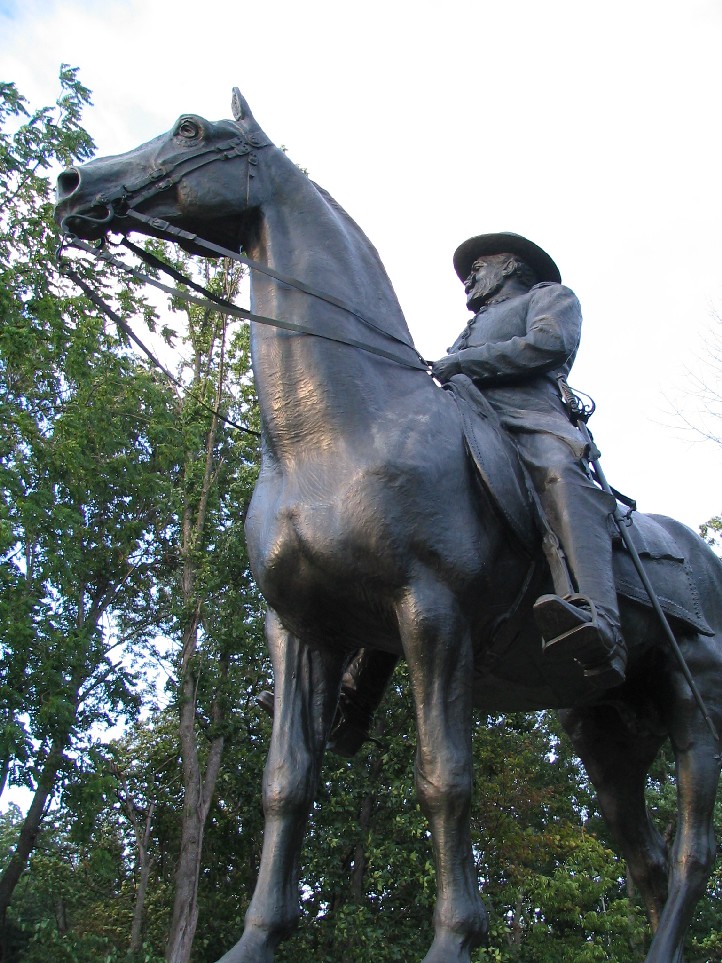
Major General John Sedgwick Statue

Dedicated June 19th, 1913


(Located approx. 500 feet north of the intersection of Wheatfield Road and Sedgwick Ave on east side)


Also See the Sculptor/Statue Related Page for additional info on this monument.


Dedicated on June 19th, 1913 the equestrian bronze statue of Major General John Sedgwick is, in my opinion, one of the finest sculptures on the Gettysburg Battlefield. The bronze, cast by Bureau Brothers of Philadelphia, stands nearly 15 feet tall mounted on a 6 foot high pedestal. The monument, in all its grandeur, is only a snapshot of the life of John Sedgwick.

Brief Bio. of General Sedgwick:

Sedgwick was born in Cornwall Connecticut . He attended the United States Military Academy  graduating in 1837 ranked 24th of 50. Commissioned a lieutenant in the U.S. Army's artillery he would fight in the Seminole War and would receive two brevet promotions during the Mexican War to captain for Contreras and Churubusco, and to major for Chapultepec. After returning from Mexico he would be transferred to the cavalry and served in Kansas, in the Utah War, and also in the Indian Wars.

In the summer and fall of 1860 Sedgwick commanded an expedition to establish a new fort on the Platte River in what is now Colorado.

At the start of the Civil War, Sedgwick served as a colonel and Assistant Inspector General of the Military Department of Washington. He missed the First Battle of Bull Run, as he was recovering from cholera. Promoted to brigadier general on August 31, 1861, he commanded the 2nd brigade of Maj. Gen. Samuel P. Heintzelman's division in the Army of the Potomac, then his own division, which was designated the 2nd division of the II Corps for the Peninsula Campaign. In Virginia, he fought at Yorktown and Seven Pines and was wounded in the arm and leg at the Battle of Glendale. He was promoted to major general on July 4, 1862.

In the Battle of Antietam, II Corps commander Maj. Gen. Edwin Sumner impulsively sent Sedgwick's division in an assault without proper reconnaissance. His division was engaged by Confederate forces under Maj. Gen. Thomas J. "Stonewall" Jackson from three sides, resulting in 2,200 casualties. Sedgwick himself was hit by three bullets, in the wrist, leg, and shoulder, and was out of action until after the Battle of Fredericksburg.

From December 26, 1862, he briefly led the II Corps and the IX Corps, and then finally the VI Corps of the Army of the Potomac, which he commanded until his death in 1864. During the Battle of Chancellorsville, his corps faced Fredericksburg in an initial holding action while Maj. Gen. Joseph Hooker’s other four corps maneuvered against Robert E. Lee’s left flank. He was slow to take action, but eventually crossed the Rappahannock River and assaulted Maj. Gen. Jubal Early’s small force on Marye's Heights. Moving west slowly to join forces with Hooker and trap Lee between the halves of the army, he was stopped by elements of Lee's Second Corps (under Maj. Gen. J.E.B. Stuart, following the death of Jackson) at the Battle of Salem Church, forcing his eventual retreat back over the Rappahannock.

At the Battle of Gettysburg, his corps arrived late on July 2 and as a result only few units were able to take part in the final Union counterattacks in the Wheatfield. In the 1864 Overland Campaign, the VI Corps was on the Union right at the Battle of the Wilderness and defended against assaults by Lt. Gen. Richard S. Ewell’s Second Corps.

Sedgwick would fall at  Battle of Spotsylvania Court House, on May 9, 1864. Confederate sharpshooters were about 1,000 yards away and their shots caused members of his staff and artillerymen to duck for cover. Sedgwick strode around in the open and was quoted as saying, "What? Men dodging this way for single bullets? What will you do when they open fire along the whole line? I am ashamed of you. They couldn't hit an elephant at this distance." Although ashamed, his men continued to flinch and he repeated, "I'm ashamed of you, dodging that way. They couldn't hit an elephant at this distance." Just seconds later he fell forward with a bullet hole below his left eye.

The remains of General Sedgwick, clad in full uniform with his features "presenting an almost life like appearance", were laid to rest on May 15th, 1864 in Cornwall. His coffin was adorned with the "dear old flag" and his sword along with a wreath sent by Mrs. Lincoln.


Photos and information provided here is from:

Dedication of the Equestrian Statue of

Major-General John Sedgwick

Erected on the Battlefield of Gettysburg

by the State of Connecticut June, 19th 1913

Hartford, Published by the State 1913

The horse "Handsome Joe" given to General Sedgwick by the men of the II Corps. The officers and men raised nearly $1700.00 to purchase the horse and equipment.

The Sculptor used the likeness of "Handsome Joe" in the monument.


 The tablets and inscriptions on the monument read the following:

Right. Bronze Tablet inscribed:

Major General John Sedgwick

Born at Cornwall, Conn. Sept. 13, 1813

Killed at Spottsylvania, Va May 9th 1864

In Command of

The Sixth Corps, Army of the Potomac

at Chancellorsville, Gettysburg,

Wilderness and Spottsylvania.

Left Bronze Tablet inscribed:

Erected by the State of Connecticut in

grateful memory of the service given

to the NAtions by her honored son

John Sedgwick

loyal citizen, illustrious soldier

beloved commander.

Front. Bronze Tablet

The Seal of Connecticut. The name

"Sedgwick" cut in granite base.

Rear. Bronze Tablet

The Sixth Army Corps Badge

(click picture to enlarge)


Dedication Day June 19th, 1913.

It was reported nearly 500 people attended the original dedication of the "Sedgwick".

Several weeks later during the 50th reunion of the Battle of Gettysburg the monument would be re-dedicated by the:

 "Sixth Corps" Society Army of the Potomac 

 on July, 1st 1913.


 The photos used on these pages are copyrighted by myself or others. They can only be copied or reproduced with written permission or the clearly legible quotation "Copyright www.gettysburgsculptures.com and linked back to this web site. Please contact me by using the Contact Gettysburg Sculptures page on this site.

Thank you!


Gettysburg Sculptures

United States